Why UX designers need a new roadmap
AI has quietly rewritten the job description of a UX designer. Tasks that once filled a sprint — synthesizing research notes, generating flow variations, producing first-draft copy — now take minutes. That doesn't make designers less valuable. It makes a different kind of designer more valuable: one who directs AI instead of competing with it.
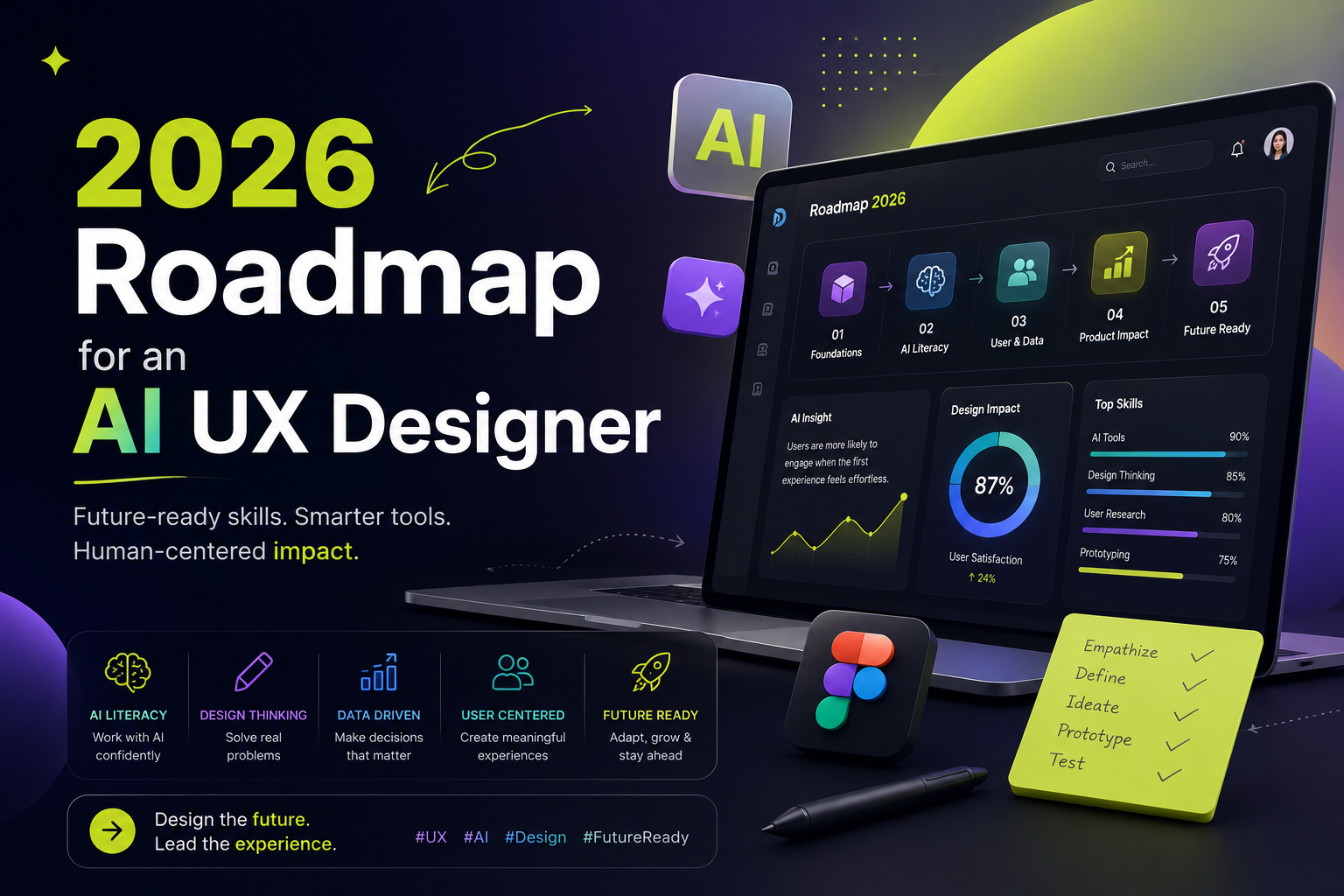
Here's a practical roadmap for staying relevant — and getting ahead — as an AI-era UX designer in 2026.
1. Master the fundamentals AI can't fake
AI can generate screens; it cannot sit with a confused user and notice the moment they hesitate. Double down on the skills that stay human:
- User research judgment — knowing which questions to ask, and which answers to distrust.
- Problem framing — defining what should be built, not just how it looks.
- Taste — the ability to look at ten AI-generated options and know why one works.
2. Make AI part of your daily workflow
Treat AI tools like junior teammates: fast, tireless, and in need of direction. In practice that means using AI for research synthesis and affinity mapping, generating divergent design directions before converging yourself, drafting UX copy variants for testing, and turning meeting notes into structured requirements. The designers who win in 2026 aren't the ones avoiding AI — they're the ones with the sharpest prompts and the strongest review instincts.
3. Learn to design for AI products
It's not just designing with AI — it's designing for it. AI products introduce brand-new UX problems: communicating confidence and uncertainty, designing for streaming responses, handling wrong answers gracefully, and building trust in systems users can't fully inspect. Portfolio projects that tackle these problems will stand out immediately.
4. Get closer to the business
As production gets cheaper, strategy gets more valuable. Learn to read activation, retention and conversion data. Connect design decisions to revenue. The designer who can say "this flow change should reduce drop-off at step three" earns a very different seat at the table.
5. Build a system mindset
AI accelerates output — which means inconsistency accelerates too, unless you have systems. Design tokens, component libraries and clear documentation stop being nice-to-haves and become the guardrails that keep AI-assisted teams coherent.
The mindset shift
Stop thinking of yourself as someone who produces screens. Start thinking of yourself as someone who produces decisions — about users, priorities and quality — and uses every tool available, AI included, to execute them faster. That's the 2026 roadmap in one sentence.
Have a project in mind?
Let's turn these ideas into your product. Talk to the Dclan team.