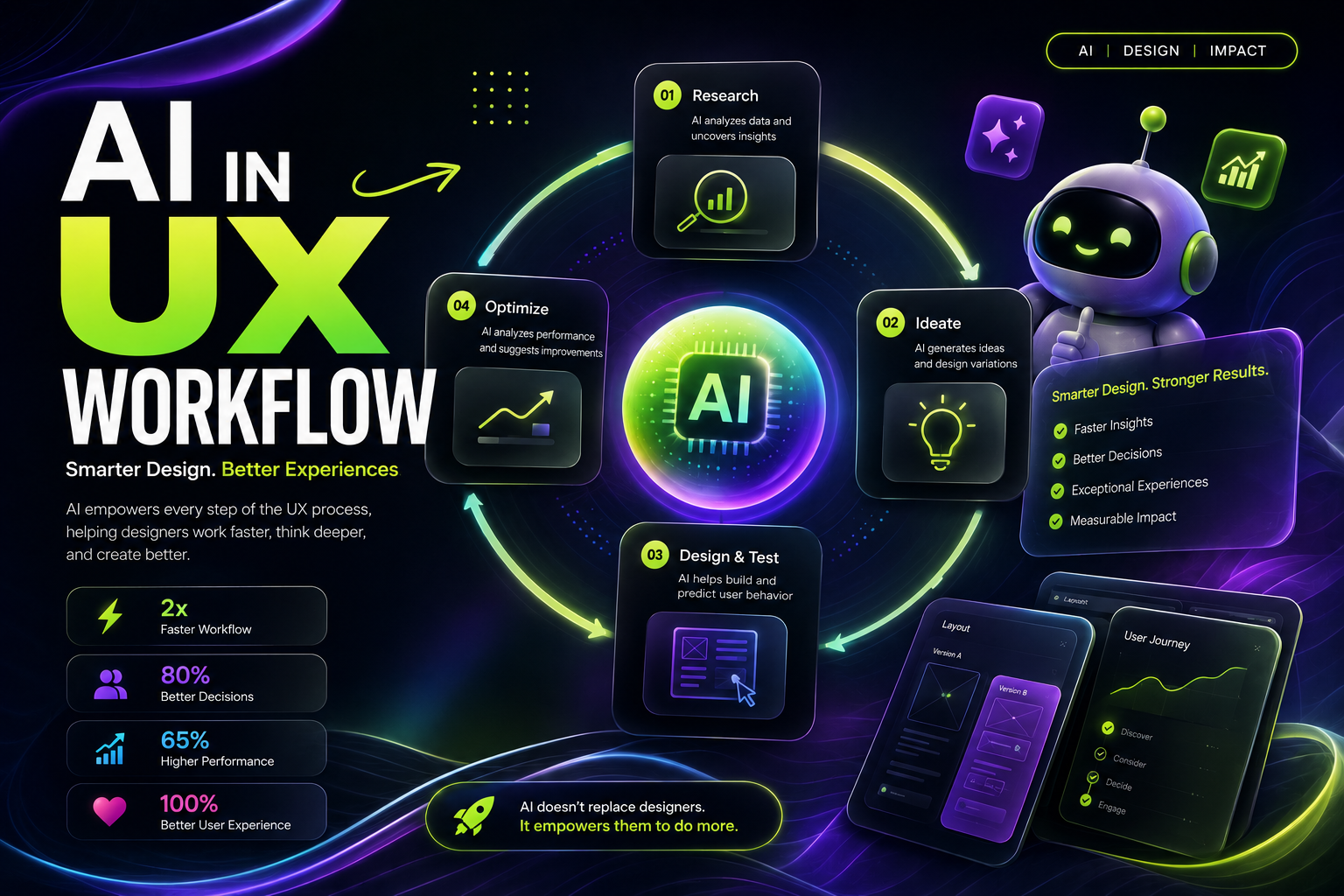
AI won't replace your UX process — it will compress it
The core UX loop — understand, ideate, design, validate — hasn't changed. What's changed is the cost of each step. Used well, AI shrinks days of production work into hours, leaving more time for the judgment calls that actually determine quality. Here's how to wire AI into each stage of your workflow.
1. Research: from raw noise to insight, faster
Feed interview transcripts, support tickets and survey responses into an AI assistant and ask for recurring themes, pain points and exact quotes. You still read the source material — AI's summaries are a map, not the territory — but affinity mapping that took two days now takes an afternoon. Bonus: ask AI to argue against your conclusions to expose bias before stakeholders do.
2. Ideation: diverge wider, converge sharper
AI is a tireless brainstorm partner. Generate ten approaches to a flow, ask for the version a competitor would build, or request the "opposite" of your current design. Most output gets discarded — that's the point. Wider divergence gives your taste more to select from.
3. Design: draft fast, craft deliberately
Use AI to produce first-pass wireframes, UX copy variants, edge-case states and placeholder content that actually resembles real data. Then do what AI can't: enforce hierarchy, brand voice and system consistency. The rule that keeps quality high — AI drafts, designers decide.
4. Validation: more tests, less overhead
AI accelerates the plumbing of research: drafting test scripts, generating task scenarios, transcribing sessions, and clustering usability findings by severity. Some teams also run early "synthetic" walkthroughs — asking AI to roleplay a first-time user — to catch obvious confusion before spending real participants on it.
5. Handoff and documentation
Turn decisions into documentation automatically: component usage notes, accessibility annotations, and change summaries for developers. Documentation is where good intentions usually die; AI keeps it alive at near-zero cost.
The guardrails
- Never ship unreviewed AI output. Every artifact gets human judgment before users see it.
- Protect user data. Anonymize research material before it touches any external tool.
- Keep the "why" human. AI can tell you what patterns exist; deciding what they mean for your product is still your job.
Teams that adopt this workflow don't just move faster — they explore more options, test more assumptions, and document more decisions. Speed is the headline; rigor is the real win.
Have a project in mind?
Let's turn these ideas into your product. Talk to the Dclan team.