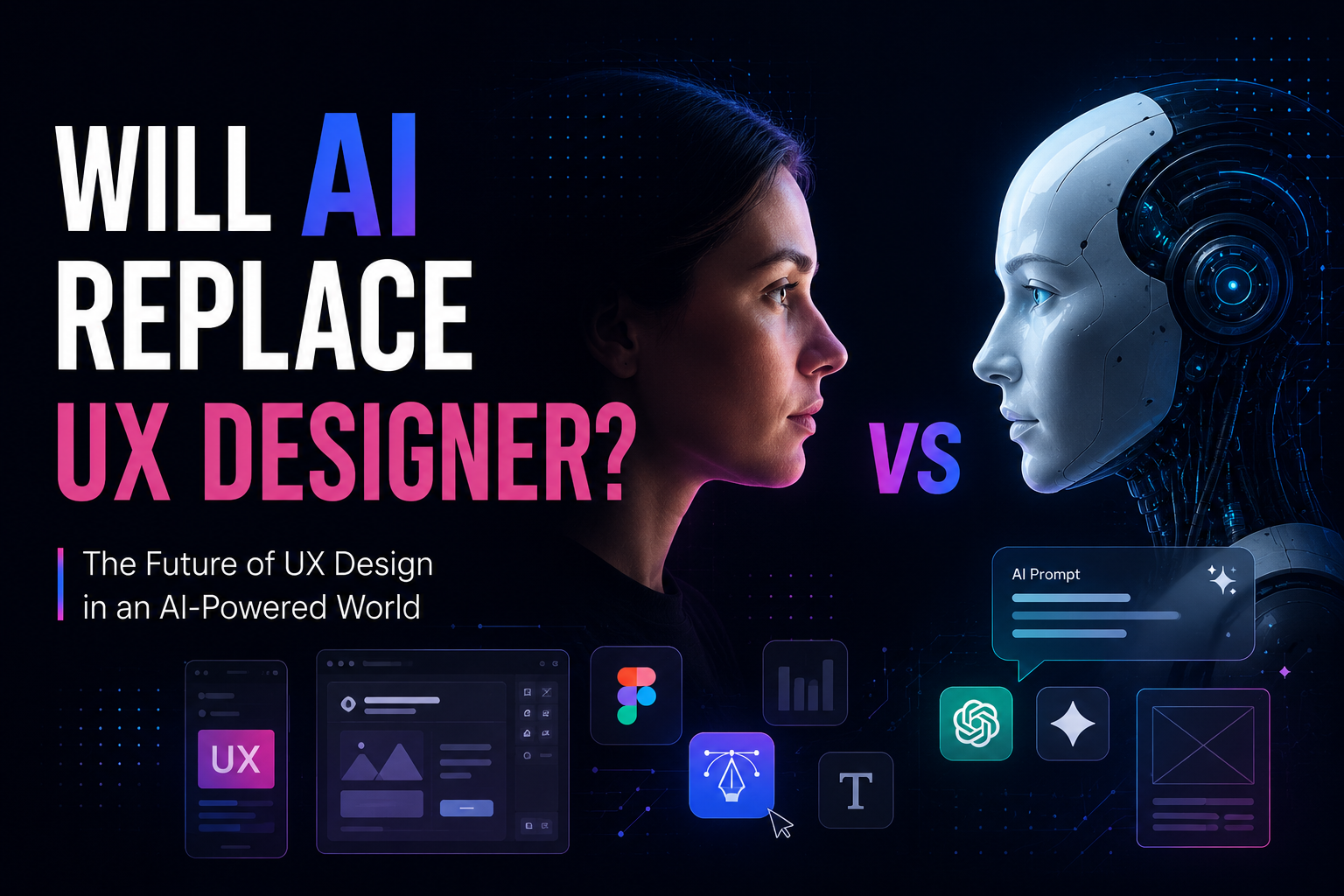
If you've typed "will AI replace UX designers" into Google recently, you're in good company — it's one of the most searched questions in the design world right now, and for good reason. AI can generate a full app layout in the time it takes to write a prompt, so it's fair to wonder whether that speed makes human designers less necessary. But speed was never really the hard part of design. The hard part has always been knowing why a user hesitates, why they abandon a cart, and why a "beautiful" screen still fails to convert once real customers get their hands on it.
The data backs this up. DigiWagon's 2026 UX research found that 54% of designers are already being pushed by stakeholders to adopt AI-generated UI trends with no clear use case behind them, and that poor UI decisions can cost businesses up to 400% in lost conversions. At the same time, the UX Design Institute's 2026 job market analysis found that roughly 70% of hiring managers still plan to bring on at least one UX professional this year, and the U.S. Bureau of Labor Statistics expects UX and digital design roles to keep growing faster than average through 2034.
In other words: AI hasn't made UX designers optional. It's made the good ones more valuable.
Why This Question Keeps Coming Up as AI Advances
Every business wants to move faster and spend less, and AI genuinely delivers on both fronts for parts of the design process. Wireframes, layout variations, and even full UI mockups can now be generated in minutes instead of days. It's easy to see why a founder or product lead might assume design has been "solved."
But this assumption usually collapses at the first usability test. NN Group's State of UX 2026 report points out that while AI is making surface-level UI cheaper and faster to produce, human direction, curation, and verification remain essential for turning that output into something users actually trust and understand. A generated screen might look complete, but looking complete and functioning well for real users are two very different things.
Is AI Actually Replacing UX Designers?
Not in the way most headlines suggest. What's actually happening is a shift in what businesses expect from the role, not a disappearance of the role itself. Figma's 2026 State of the Designer survey found that 73% of hiring managers see a growing need for designers who are proficient with AI tools, and 79% say the same specifically for designing AI-powered products. That's not a sign of designers being phased out — it's a sign that the bar for what a UX designer needs to bring to the table has gone up.
At the same time, over half of hiring managers surveyed by Figma said visual polish, systems thinking, and product strategy remain among the most important skills they look for — none of which AI can fully replace on its own. The pattern across nearly every serious industry report in 2026 is consistent: businesses aren't hiring less design talent, they're hiring for a more strategic, AI-literate version of the same expertise.
What AI Does Well in the Design Process
To be fair to the technology, AI has earned its place in modern design workflows. It genuinely helps with:
Speeding Up Repetitive Work — Generating wireframe variations, resizing assets across screen sizes, and producing first-draft layouts happen in a fraction of the time they used to take.
Automating Usability Testing Logistics — AI can now run unmoderated usability sessions and summarize hours of user interviews into digestible highlights, freeing designers from manual transcription work.
Predicting Where Users Might Struggle — Pattern recognition across large datasets can flag likely friction points before a design even reaches real users.
Personalizing Experiences at Scale — AI can tailor content, recommendations, and interface elements to individual users in ways that would be impossible to do manually across a large user base.
These are real, valuable capabilities. But every one of them produces raw material or a first draft — not a finished, trustworthy user experience.
What Only a Human UX Designer Can Still Do
This is where the businesses skipping human design expertise tend to run into trouble.
Understanding Why, Not Just What — AI can tell you that users are dropping off at a certain screen. It takes a human designer's judgment, research skills, and empathy to understand why — and to design a fix that solves the actual problem instead of a symptom of it.
Making Judgment Calls With Incomplete Information — Real design work constantly involves trade-offs between business goals, technical constraints, and user needs that don't have a clean data-backed answer. That kind of judgment is exactly what NN Group's 2026 report says will keep human direction essential, even as AI's raw capabilities improve.
Validating AI's Own Output — Ironically, one of the fastest-growing responsibilities for UX designers is reviewing and correcting AI-generated interfaces before they ship. Research on generative UI tools has repeatedly found issues like misaligned components, unreadable text, and inconsistent patterns that require a trained eye to catch.
Building Trust Into AI-Powered Products — As more products embed AI features and agents, NN Group's research flags trust as one of the defining UX challenges of 2026. Users who've been burned by a confusing AI feature become hesitant to adopt the next one — and designing for transparency, control, and graceful failure is fundamentally a human-centered design problem.
Why Skipping UX Designers Costs Businesses More Later
The instinct to cut design costs by leaning entirely on AI tools is understandable, but the numbers tell a different story.
The upside of investing in UX:
- DigiWagon's research puts the average return on UI/UX investment at $100 for every $1 spent
- A well-designed interface can lift conversion rates by up to 200%
- A full UX strategy can push that figure toward 400%
The cost of getting it wrong:
- Research consistently shows that 88% of users won't return to a website after a single bad experience
For a growing business, that last number isn't a minor inconvenience — it's a direct, compounding hit to customer acquisition cost, since every visitor lost to a poor experience is one your marketing budget has to replace all over again.
How to Build a UX Team That Works Well Alongside AI
The businesses getting the best results in 2026 aren't choosing AI over UX designers, or vice versa — they're combining both deliberately:
- Use AI to accelerate early-stage wireframing and research synthesis, but have a designer review and refine every output before it reaches users.
- Prioritize hiring designers who are AI-tool fluent, not just traditionally trained — this is now one of the fastest-growing requirements in design job listings.
- Keep usability testing human-led, especially for anything customer-facing, since AI-based testing tools can still miss subtle moments of user hesitation or confusion.
- Treat AI as a way to free up designer time for higher-value strategic work — not as a replacement for the strategic thinking itself.
Wrapping Up
AI has changed how design work gets done, but it hasn't changed why design work matters. Businesses that treat UX design as an optional layer — something AI can simply generate on demand — consistently end up paying for that decision later, in lost conversions, lost trust, and lost customers who never come back. The businesses winning in the age of AI aren't the ones replacing designers with prompts. They're the ones giving skilled UX designers better tools to work faster, while still trusting human judgment to decide what actually earns a customer's confidence.
Frequently Asked Questions (FAQ)
Will AI eventually replace UX designers completely?
Most current industry research doesn't support that outcome. AI is changing what tools designers use and what skills are in demand, but the core judgment, research, and strategic thinking UX designers provide remain difficult to automate.
Is it cheaper to just use AI tools instead of hiring a UX designer?
It can seem cheaper upfront, but poor usability from unreviewed AI-generated design has been linked to significant conversion losses. Many businesses end up spending more on fixes and lost customers than they would have on proper UX design from the start.
What should businesses look for when hiring UX designers in 2026?
Look for designers who combine traditional UX fundamentals — research, usability, systems thinking — with fluency in AI design tools. This combination is increasingly what employers report prioritizing in hiring.
Can small businesses benefit from UX designers, or is it only for large companies?
Small businesses often benefit the most, since a single UX fix — like a simplified checkout or clearer navigation — can meaningfully move conversion rates without requiring a large marketing budget increase.
How does AI actually help UX designers do their job better?
AI speeds up repetitive tasks like wireframing, testing logistics, and research summarization, giving designers more time to focus on the strategic, judgment-based work that most directly impacts customer trust and conversions.
Have a project in mind?
Let's turn these ideas into your product. Talk to the Dclan team.